
Suncity 2 Dragon Tiger Guide: Rules, Odds and Tie Risk
One card for Dragon, one for Tiger, highest wins. It is the simplest table in the live lobby, which is exactly why the tie rule and the speed of play matter so much.
- 📖 4 min read
- 🗂️ Dragon Tiger
- 🗓️ Updated November 2026
- 18+ only

In Dragon Tiger, one card is dealt to Dragon and one to Tiger, and the higher card wins; both main bets pay 1 to 1. On a tie, most tables take half of your Dragon or Tiger stake, which gives a house edge of about 3.7%. The Tie bet itself costs far more, roughly 32.8% at 8 to 1, so it is best avoided.
This article covers Dragon Tiger rules and odds for readers of Club Suncity 2. For other live and multiplayer tables, see Club Suncity 2 games.
How Dragon Tiger is dealt
Dragon Tiger is usually played with six or eight standard decks. After bets close, the dealer places one card face up in the Dragon box and one in the Tiger box. Whichever card ranks higher wins. There are no third cards, no drawing rules and no player decisions after betting, so a full round can take as little as 20 to 30 seconds.
Card ranking is simple: King is highest, followed by Queen, Jack and 10 down to 2, with Ace counting as the lowest card on most tables. Suits do not decide the winner of the main bet; they only matter for certain side bets.
Dragon and Tiger: the main bets
Betting on Dragon or Tiger pays 1 to 1 when your side has the higher card. The two bets are mirror images, so neither has an advantage. With eight decks, each side wins about 46.3% of rounds and a tie happens about 7.5% of the time.
The tie rule decides the cost. On most tables, when Dragon and Tiger show the same rank, Dragon and Tiger bets lose half their stake. That rule produces a house edge of about 3.7%. A few tables take the full stake on a tie instead, which roughly doubles the edge to around 7.5%, so it is worth checking which rule your table uses before your first bet.
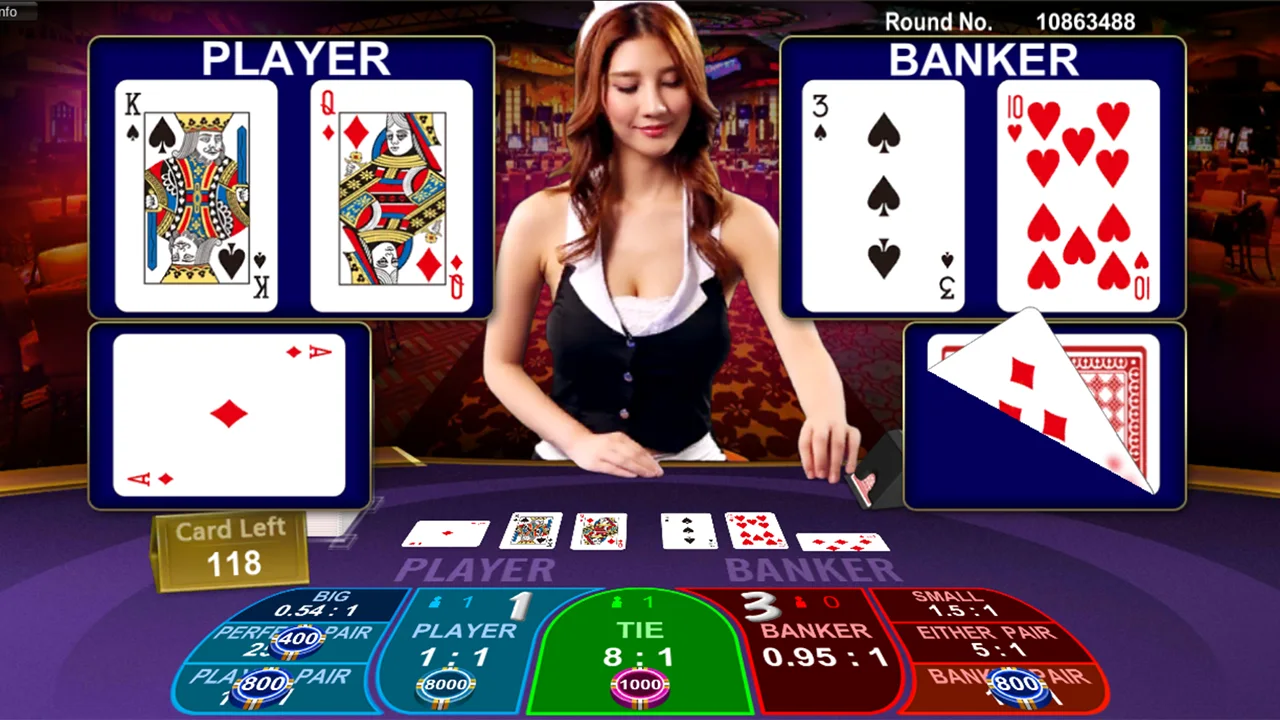
The Tie bet and suited tie
The Tie bet wins when both cards share the same rank. It looks tempting because it pays 8 to 1, sometimes 11 to 1. But with a 7.5% chance of landing:
- Tie at 8 to 1: house edge about 32.8%.
- Tie at 11 to 1: house edge about 10.4%.
- Suited tie at 50 to 1 (same rank and suit): house edge about 14%.
For comparison, the main bets cost about 3.7%. Placing 10 credits on Tie every round for 100 rounds at 8 to 1 would cost around 328 credits on average, compared with roughly 37 on Dragon or Tiger.
Side bets: Big, Small, Odd, Even, Red, Black
Many tables add side bets on a single card, such as whether the Dragon card is Big (8 to King) or Small (Ace to 6), Odd or Even, or Red or Black. These pay 1 to 1, but the bet usually loses if the card is a 7. Because 7 is one of the 13 ranks, that rule gives an edge of about 7.7%, roughly double the main bets.
Side bets also multiply the number of decisions per round. If you add two side bets to a main bet, you are effectively playing three games at once at a faster pace, which accelerates spending.
Speed and session planning
Dragon Tiger’s speed is its biggest risk. At around 120 rounds an hour, a 10-credit Dragon bet each round means 1,200 credits wagered in that hour and an expected cost near 45 credits at 3.7%. That is about twice as many rounds as a typical baccarat table in the same time.
- Set a time limit as well as a money limit, because rounds pass quickly. Our session limits guide shows how.
- Skip rounds rather than betting on every one.
- Leave the Tie bet alone, or keep it to a tiny fixed amount.
- Ignore result boards; each deal is independent, just as in baccarat roadmaps.
Dragon Tiger vs baccarat
Dragon Tiger is often described as one-card baccarat. The difference is that baccarat uses drawing rules and gives Banker a small structural advantage, which is why it charges commission. Dragon Tiger has no drawing rules, so the house edge comes entirely from the tie rule instead. Baccarat’s main bets are slightly cheaper at about 1.06% on Banker and 1.24% on Player, while Dragon Tiger is faster and simpler. See Banker vs Player rules for the baccarat side of the comparison.
Before you join a live table
Open the rules panel and confirm four things: how ties are settled on Dragon and Tiger bets, the Tie payout, whether side bets lose on a 7, and the table’s minimum and maximum bet. Live tables stream video, so if the picture stutters, read about stream lag before betting; a frozen stream can make you miss the short betting window.
Frequently Asked Questions
Is Dragon or Tiger the better bet?
Neither. They are mirror images with the same odds and the same house edge.
What happens to my Dragon bet on a tie?
On most tables you lose half the stake. Some tables take the full stake, so check the rules.
How is an Ace ranked in Dragon Tiger?
On most tables the Ace is the lowest card and the King is the highest.
Why is the Tie bet so expensive?
A tie happens about 7.5% of the time, but 8 to 1 pays as if it happened about 11% of the time. The gap is the house edge.
Can card counting work in Dragon Tiger?
Shoes are large and often reshuffled, so any effect is too small to overcome the house edge in practice.
Related Articles
Baccarat Banker Commission: What It MeansBaccarat →Baccarat Tie Bet: Rules and Risk ExplainedBaccarat →Baccarat Roadmaps: Why Patterns Do Not PredictBaccarat → Club Suncity 2 Android Requirements ExplainedInstallation →Club Suncity 2 APK Won’t Install? Fix GuideInstallation →
 Wi-Fi vs Mobile Data: App Connection TroubleshootingConnection →